Authentic Middle Eastern Knafeh Recipe
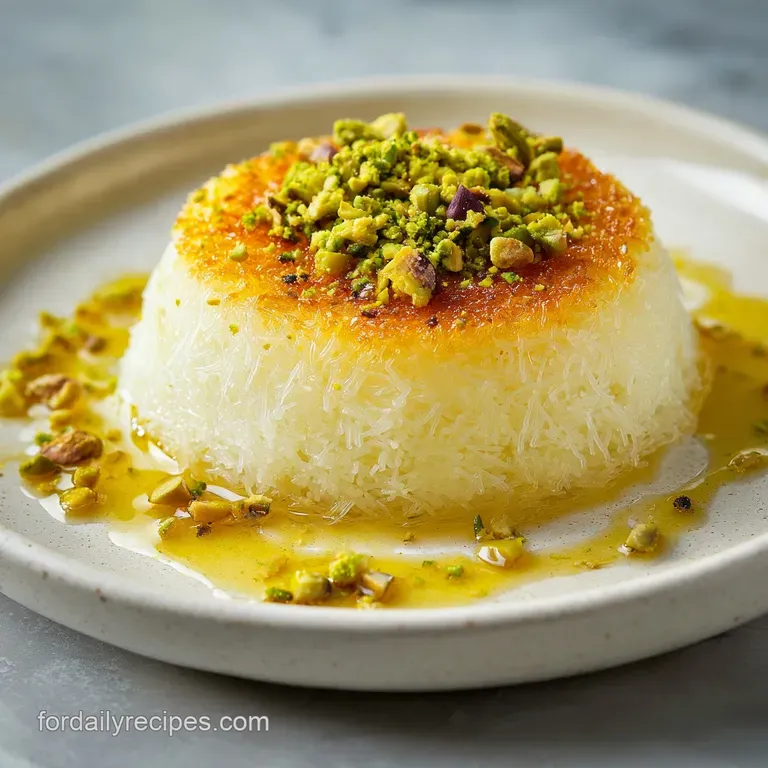
- Time: Active 20 minutes, Passive 25 minutes, Total 45 minutes
- Flavor/Texture Hook: Shatter crisp pastry meeting a velvety, molten cheese core.
- Perfect for: Weekend gatherings and extraordinary celebrations.
- Mastering the Authentic Middle Eastern Knafeh
- Science of the Perfect Crunch
- Component Analysis Deep Dive
- Essential Flavor Components
- Critical Kitchen Tools
- Assembling the Golden Layers
- Solving Common Texture Issues
- Smarter Ingredient Swaps
- Storage and Reheating Tips
- Finishing with Global Style
- Recipe FAQs
- 📝 Recipe Card
Mastering the Authentic Middle Eastern Knafeh
The first time I stood in a tiny bakery in Amman, the aroma of orange blossom water and sizzling ghee hit me before I even saw the trays. I watched the baker pour cold, crystal clear syrup over a blistering hot pan of shredded dough, and the sound - that aggressive, beautiful "shish" - was enough to make me a devotee for life.
There is something about the contrast of the salty, squeaky cheese pull and the floral sweetness that transcends borders and makes every bite feel like a celebration.
I used to struggle with getting that signature crunch at home, often ending up with a soggy base or cheese that turned into a rubbery puck. After months of testing different ratios and cheese blends, I realized the secret isn't just in the ingredients, but in the thermal shock of the syrup.
This Middle Eastern Knafeh recipe isn't just another sweet treat; it is a study in texture that we have finally perfected for the home kitchen. Trust me, once you hear that pastry shatter under your fork, you will never look back.
But what about the cheese? Many recipes suggest just using mozzarella, but that misses the depth of flavor. We are going to blend it with desalted Akawi and a touch of ricotta to get that professional finish.
It is a little extra work to prep the cheese, but honestly, don't even bother with a single cheese version if you want the real deal. Let's get into the details of how to make this extraordinary.
Science of the Perfect Crunch
Thermal Shock: Pouring room temperature syrup over a 350°F crust creates a rapid pressure change that forces the syrup into the pastry without dissolving the starch structure.
Osmotic Balance: The lemon juice in our syrup acts as an invert sugar agent, preventing the sucrose from recrystallizing into a grainy mess as it cools.
Moisture Migration: Using low moisture mozzarella prevents the cheese from releasing excess whey during baking, which would otherwise steam the kataifi from the inside out.
Fat Saturation: Ghee has a higher smoke point than butter, allowing the fine kataifi strands to fry until golden without the milk solids burning and turning bitter.
| Method | Time | Texture | Best For |
|---|---|---|---|
| Large Baking Pan | 25 minutes | Soft center, crispy edges | Large family gatherings |
| Individual Ramekins | 15 minutes | Maximum edge crunch | Dinner party presentation |
| Stovetop Skillet | 20 minutes | Extra charred bottom | Authentic street food style |
The choice of method depends on how much of that "crunch to cheese" ratio you prefer. Personally, I love the large pan for the way the syrup pools in the middle. If you are looking for more adventurous flavors to round out your spread, this pairs beautifully with a Middle Eastern Halva recipe on the side.
Component Analysis Deep Dive
| Ingredient | Science Role | Pro Secret |
|---|---|---|
| Kataifi Pastry | Provides structural surface area | Pulse in a processor for even browning |
| Desalted Akawi | Provides the elastic "pull" | Soak in water for 24 hours to remove salt |
| Ghee | Conducts heat through the fibers | Freeze for 10 minutes to grate into dough |
Essential Flavor Components
- 500g kataifi pastry, thawed Why this? Shredded phyllo dough creates the signature bird's nest texture. (Substitute: Shredded phyllo dough)
- 200g ghee, melted Why this? High smoke point ensures a deep golden color without burning. (Substitute: Clarified butter)
- 2 tbsp granulated sugar Why this? Aids in the Maillard reaction for the crust. (Substitute: Powdered sugar)
- 300g low moisture mozzarella cheese, shredded Why this? Provides the iconic stretchy cheese pull. (Substitute: Mild Provolone)
- 200g Akawi cheese, desalted and drained Why this? Adds the traditional slightly tangy, salty depth. (Substitute: Halloumi, desalted)
- 100g fresh ricotta cheese Why this? Softens the texture of the melted cheese core. (Substitute: Mascarpone)
- 400g granulated sugar for syrup Why this? Creates a heavy, coating sweetness. (Substitute: Honey water blend)
- 240ml water Why this? The base for the floral attar syrup. (Substitute: Rose water tea)
- 1 tsp lemon juice Why this? Prevents the sugar syrup from crystallizing. (Substitute: Citric acid pinch)
- 1 tbsp rose water Why this? Classic aromatic floral note. (Substitute: Vanilla extract)
- 1 tbsp orange blossom water Why this? Rounds out the floral profile. (Substitute: Orange zest)
Critical Kitchen Tools
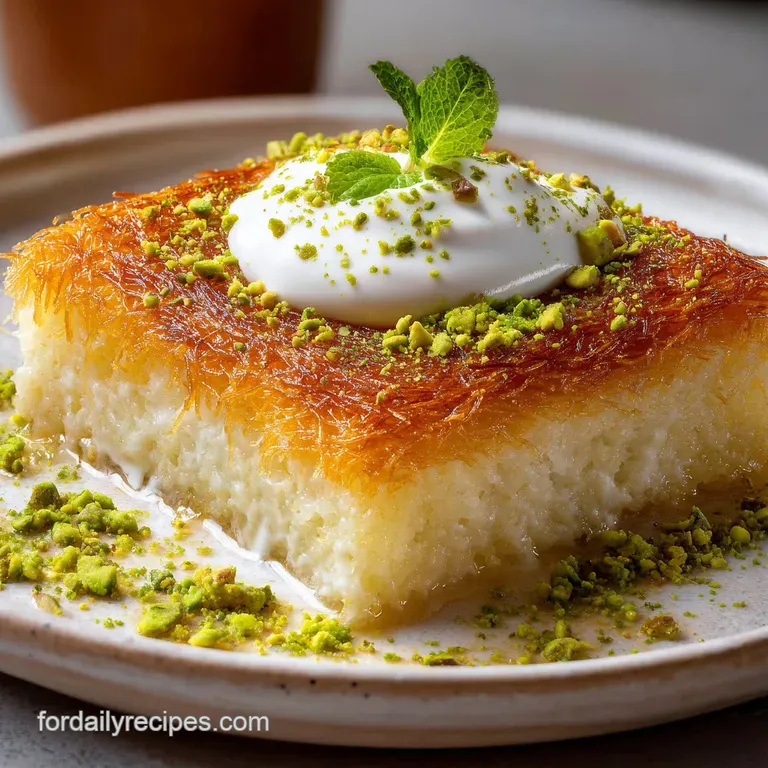
You won't need anything too fancy, but a 12 inch round baking pan (specifically a shallow one) is the traditional choice for getting that even bake. A food processor is a massive time saver for breaking down the kataifi into 1 inch strands. If you don't have one, a sharp chef's knife and some patience will do.
You also need a small saucepan to simmer the syrup and a heavy bottomed weight (like another pan) to press the pastry into the base.
| Feature | Fresh Kataifi | Frozen Shortcut |
|---|---|---|
| Handling | Very delicate, requires immediate use | Sturdy, needs thorough thawing |
| Texture | Feather light and airy | Slightly denser, more crunch |
| Availability | Specialty Middle Eastern grocers | Most large supermarket freezers |
Assembling the Golden Layers
- Simmer 400g sugar, 240ml water, and 1 tsp lemon juice for 10 minutes. Note: This creates a thick syrup that won't make the pastry soggy.
- Stir in 1 tbsp rose water and 1 tbsp orange blossom water, then set aside to cool completely.
- Pulse 500g thawed kataifi in a food processor until it reaches 1 inch lengths. until evenly shredded.
- Rub the kataifi with 200g melted ghee and 2 tbsp sugar using your hands. Note: Ensure every strand is coated for maximum crispiness.
- Press two thirds of the pastry firmly into a greased 12 inch pan. until a solid base forms.
- Mix the 300g mozzarella, 200g desalted Akawi, and 100g ricotta in a bowl.
- Spread the cheese mixture over the pastry, leaving a 1/2 inch border at the edges. Note: This prevents the cheese from sticking to the pan walls.
- Cover with the remaining pastry and bake at 350°F (180°C) for 25 minutes. until edges are golden and pulling away.
- Remove from the oven and immediately pour the cooled syrup over the hot pastry. until the sizzle subsides.
- Flip onto a serving plate and garnish with crushed pistachios.
This process is very similar to the layering technique used in a traditional Kibbeh Recipe, where pressure and fat distribution are key to the final texture.
Solving Common Texture Issues
The Pastry Is Saturated And Soft
This usually happens when the syrup and the pastry are both hot. The temperature differential is vital. If your syrup is warm, it will soak into the dough fibers and dissolve them instead of coating them. Always make the syrup first so it has at least 30 minutes to reach room temperature.
The Cheese Is Too Salty
Akawi and Halloumi are stored in brine. If you don't soak them properly, the dessert will taste like a savory snack. You must slice the cheese and soak it in cold water, changing the water every few hours, until it loses its saltiness.
| Problem | Root Cause | Solution |
|---|---|---|
| Greasy bottom | Ghee was not fully incorporated | Rub fat into dough until no dry spots remain |
| Cheese won't pull | Used high moisture fresh mozzarella | Stick to low moisture "pizza" style cheese |
| Pale crust | Oven temperature was too low | Increase to 375°F for the last 5 minutes |
Common Mistakes Checklist - ✓ Desalt the Akawi for at least 4 hours (ideally 24) to avoid a salt bomb. - ✓ Use a heavy pan to press the bottom layer of kataifi into a tight disc. - ✓ Never pour hot syrup on hot pastry; one must be cool.
- ✓ Leave a border around the cheese to prevent it from burning against the pan. - ✓ Thaw kataifi in the fridge overnight, not on the counter, to prevent gummy strands.
Smarter Ingredient Swaps
If you are looking to scale this down, you can easily halve the recipe and use an 8 inch cake pan. Just reduce the baking time by about 5 minutes. When scaling up for a crowd, it is better to make two separate trays rather than one giant one, as the middle of a massive tray often struggles to get crispy before the edges burn.
For a vegan version, use a high-quality vegan butter substitute and a mixture of cashew cream and almond based "mozzarella." The texture will be different more creamy than stretchy but the floral syrup still carries the dish beautifully.
If you can't find kataifi, some people use coarse semolina (known as Knafeh Na'ameh), which results in a smoother, cookie like crust.
Storage and Reheating Tips
Knafeh is best eaten within 20 minutes of coming out of the oven. However, if you have leftovers, store them in the fridge for up to 3 days. Do not microwave it; the pastry will become rubbery and the cheese will lose its soul.
Instead, reheat slices in a dry skillet over medium low heat or in a 350°F oven for 10 minutes to bring back the crunch.
For zero waste, any leftover shredded kataifi can be tossed with sugar and butter and baked into little "nests" to top fruit salads. If you have extra syrup, it stays good in a jar for months and is amazing in iced coffee or over pancakes.
Finishing with Global Style
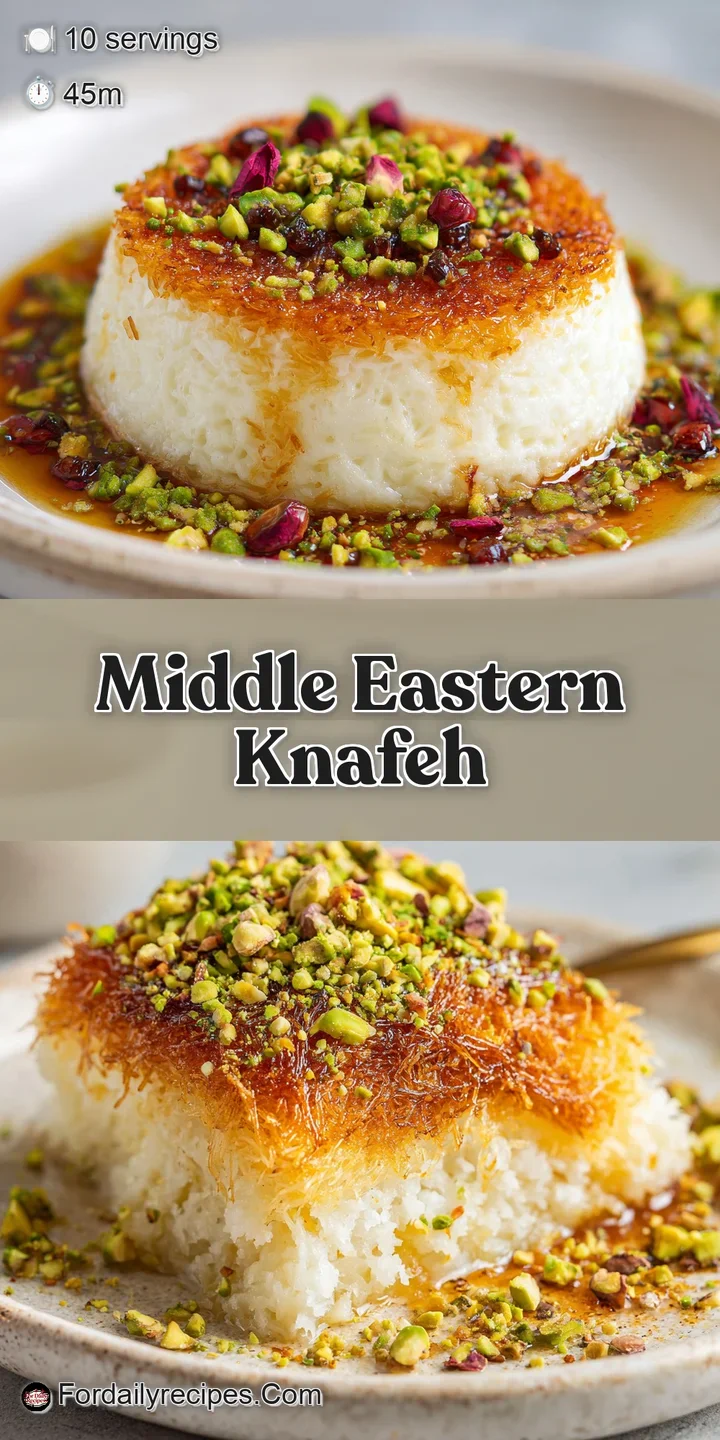
Presentation is everything with Middle Eastern Knafeh. Once you flip it, the bottom (now the top) should be a stunning, uniform orange gold. Use a generous hand with the bright green crushed pistachios the color contrast is half the appeal.
I love serving this with a small dollop of clotted cream (Ashta) or a side of bitter Arabic coffee to balance the sugar.
If you want to get fancy, you can add dried edible rose petals on top. It gives it that "extraordinary" look we talked about. Remember, this dish is meant to be shared right from the plate while the cheese is still molten. It's a communal experience that truly transcends borders. For more inspiration on shared platters, check out my Authentic Persian Koobideh recipe for your next dinner party.
Recipe FAQs
What ingredients is Middle Eastern Knafeh made of?
The core ingredients are kataifi pastry, ghee, and a mix of three cheeses. Specifically, it uses shredded phyllo dough (kataifi), clarified butter (ghee), sugar, and a blend of cheeses like Akawi, low-moisture mozzarella, and ricotta.
What does 'knafeh' mean or translate to in Arabic?
Knafeh is the English transliteration of the Arabic word for the pastry itself. In Arabic, it is written as كنافة (Kunāfah), referring to the delicate shredded pastry dough used to create the dish.
Is knafeh the exact same thing as kunafa?
Yes, kunafa is the same dish as knafeh. The difference in spelling is simply a common phonetic variation arising from transliterating the Arabic word كنافة into English.
Is knafeh Turkish or Arab in origin?
It is firmly rooted in Arab cuisine, though variations exist across the Levant. While the Ottoman Empire influenced many regional dishes, Knafeh is predominantly recognized as a classic Levantine dessert from areas like Palestine, Jordan, and Syria.
How to properly prepare the Akawi cheese for Knafeh?
Slice the cheese and soak it in cold water, changing the water every few hours. This process, called desalinating, is crucial to remove the brine's intense saltiness so the final dessert balances sweet and savory.
Why must the syrup be cool when poured over the hot Knafeh?
Pouring cool syrup over hot pastry creates a thermal shock that achieves the signature shatter. If both are hot, the syrup dissolves the starch structure, resulting in a soggy texture rather than a crisp crust; mastering this heat exchange is key to the texture, similar to how proper temperature control sets the proteins in our Burger Patty Recipe.
What can I serve alongside Knafeh to cut the sweetness?
Serve it with something sharply acidic or slightly savory to contrast the intense sugar. A strong, unsweetened Arabic coffee is traditional, but a side of fresh, tangy vegetables works well; try a small portion of our Sumac Onion Salad Recipe for a unique savory pairing.
Authentic Middle Eastern Knafeh
Ingredients:
Instructions:
Nutrition Facts:
| Calories | 641 kcal |
|---|---|
| Protein | 14.8 g |
| Fat | 32.4 g |
| Carbs | 74.8 g |
| Fiber | 1.2 g |
| Sugar | 42.5 g |
| Sodium | 364 mg |
