Egusi and Fufu: Authentic West African Comfort Food
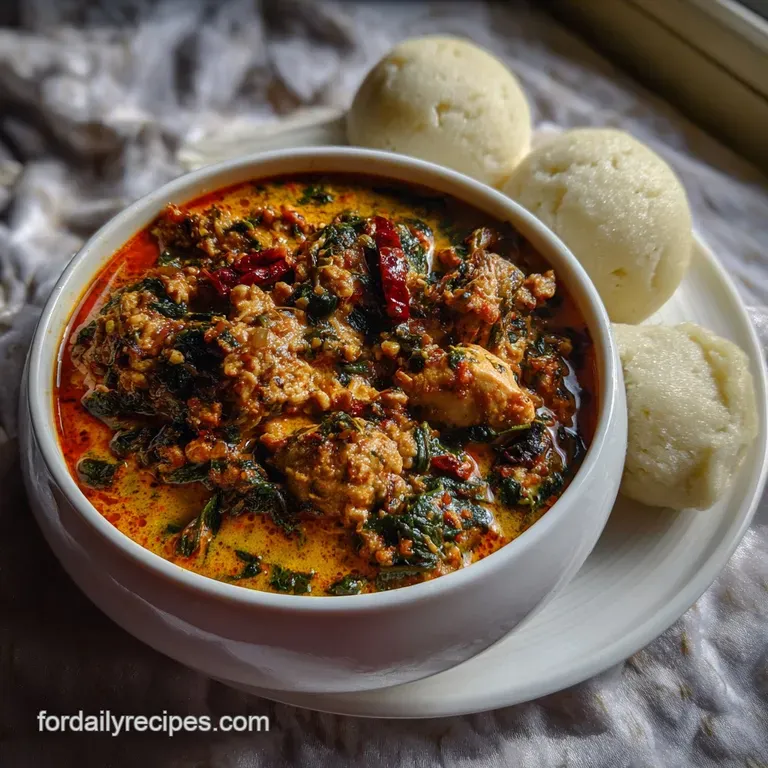
- Effort/Time: High-effort technique | 1 hour 45 minutes total
- Flavor Hook: Nutty, umami-rich soup meets the tangy, elastic pull of fufu.
- Perfect for: Weekend family feasts or nutrient-dense meal-prepping.
- The Physics of Protein and Starch: Master the Ultimate egusi and fufu
- Nutritional Benchmarks and Temporal Logistics
- The Alchemy of Umami: Selecting Your Elements
- Precision Technical Tooling for Egusi Success
- Thermal Execution: Key Steps for egusi and fufu
- Why Your Egusi Soup Separates: Pro Troubleshooting
- ⚗️ The Scaling Lab: Physics of Large-Batch Cooking
- Flavor Architecture: Creative Variations
- Common Myths vs. Scientific Reality
- Storage and Zero Waste Philosophy
- Serving Suggestions: The Tactile Experience
- Recipe FAQs
- 📝 Recipe Card
There is nothing more demoralizing than investing hours into a pot of soup only to have the egusi seeds separate into a watery, gritty mess that looks more like curdled milk than a rich stew.
I once served a batch to my in-laws where the red palm oil sat in a greasy slick on top while the beef remained tough and unyielding, a classic failure of heat management and timing that cost me a week’s grocery budget in wasted protein. It was a texture failure that no amount of seasoning could mask.
I spent months destroying batches, rushing the fufu hydration or over boiling the greens until they turned to grey mush, before I realized that West African cooking is a game of thermodynamics and protein denaturation.
I learned the hard way that you cannot treat ground melon seeds like a thickener; you have to treat them like an emulsion. If the temperature drops too fast or the water ratio is off, the structural integrity of the "clumps" vanishes instantly.
The secret to this egusi and fufu isn't just the spices; it's the specific technique of "frying" the egusi paste in red palm oil to toast the proteins before hydration.
This allows the lipids to encapsulate the seed particles, creating a velvety mouthfeel and preventing the "seedy" grit common in amateur versions. When paired with the elastic, starch heavy fufu, the result is a sensory experience defined by the contrast between a savory, nutty sizzle and a smooth, tangy swallow.
The Physics of Protein and Starch: Master the Ultimate egusi and fufu
This recipe works because it relies on the chemical transformation of ground melon seeds into a stable, curd like matrix. By creating a paste with 2.5 cups ground egusi seeds and 0.5 cup water, you initiate a protein binding process that, when introduced to the hot 1 cup red palm oil, undergoes a rapid Maillard reaction, intensifying the nutty flavor.
The high fat content of the palm oil acts as a heat conductor, ensuring the seeds cook through without burning, while the 0.5 cup ground crayfish provides a massive hit of natural glutamates for deep umami.
The fufu portion of this egusi and fufu pair relies on starch gelatinization. As you stir the 4 cups fufu flour into 3 cups boiling water, the starch granules swell and burst, creating a cross linked network of molecules that provides that signature "stretch" and "pull." Unlike wheat based doughs that rely on gluten, fufu relies on the high amylopectin content of fermented cassava to achieve its characteristic elasticity and smooth, non-stick surface.
- Lipid Emulsification: Toasting the egusi seeds in palm oil prevents the soup from separating into oil and water.
- Collagen Hydrolysis: Simmering 2 lbs beef chuck and 1 lb assorted meats for 1 hour 15 mins converts tough connective tissue into silky gelatin.
- Starch Retrogradation Control: Continuous vigorous stirring of the fufu prevents the formation of hard, unhydrated starch lumps.
- Umami Synergism: Combining 1 tbsp iru (fermented locust beans) with 1 cup smoked fish creates a complex flavor profile that stimulates all taste receptors.
Nutritional Benchmarks and Temporal Logistics
Making egusi and fufu requires a disciplined approach to time and heat. The 1 hour 15 mins cook time is non-negotiable for the beef chuck to reach the "pull apart" stage where internal temperatures exceed 195°F (90°C), allowing the collagen to melt. This isn't just a meal; it's a high protein, high fat fuel source designed for long term satiety, similar in satisfaction to the hearty profile found in a Chicken and Dumplings recipe.
| Metric | Value |
|---|---|
| Total Time | 1 hour 45 minutes |
| Prep Time | 30 minutes |
| Cook Time | 1 hour 15 minutes |
| Calories | 1142 kcal per serving |
| Protein | 58 g |
| Total Fat | 76 g |
| Carbohydrates | 62 g |
| Yield | 6 Servings |
The Alchemy of Umami: Selecting Your Elements
Success in an egusi and fufu project depends entirely on the quality of your fats and proteins. We use 1 cup red palm oil specifically for its high smoke point and distinct carotenoid rich flavor. Using a substitute like vegetable oil will result in a flat, one-dimensional profile.
Ingredient Chemistry Breakdown
| Ingredient | Chemical/Physical Role (Science) | The Pro Secret (Why This Matters) |
|---|---|---|
| Egusi Seeds | High protein/lipid emulsifier | Creates "clumps" that mimic the texture of cooked eggs. |
| Red Palm Oil | Saturated fat heat conductor | Carries fat-soluble vitamins and provides the mahogany color. |
| Iru (Locust Beans) | Microbial fermentation | Adds volatile aromatic compounds and deep umami. |
| Fufu Flour | Fermented starch gelatinization | Provides the structural "vessel" for the soup. |
Technical Shopping List
- 2 lbs beef chuck, cubed: Why this? High collagen content provides a rich, viscous mouthfeel after braising.
- 1 lb assorted meats (tripe and cow skin): Adds varied tactile resistance and textural complexity.
- 1 cup red palm oil: Why this? Essential for the signature aroma and preventing "dry" seed texture.
- 2.5 cups ground egusi seeds: The protein backbone of the soup.
- 4 cups fufu flour (fermented cassava flour): Why this? High starch density creates the necessary elastic pull.
- 1 tbsp iru (fermented locust beans): The funk factor that bridges the gap between bitter and savory.
- 2 red bell peppers and 3 scotch bonnets: Blended for a capsicum kick that balances the heavy fats.
- 0.5 cup ground crayfish: Acts as a natural flavor enhancer (MSG alternative).
- 4 cups fresh spinach, chopped: Provides a vibrant chlorophyll contrast and fiber.
| Original Ingredient | Substitute | Why It Works |
|---|---|---|
| Beef Chuck | Goat Meat | Leaner but adds a gamey, authentic depth. |
| Fresh Spinach | Bitter Leaf | Traditional but significantly more bitter; requires thorough washing. |
| Red Palm Oil | Annatto infused Coconut Oil | Mimics the color and has high fat, but lacks the specific earthy funk. |
Precision Technical Tooling for Egusi Success
- Lodge 6 Quart Dutch Oven: The heavy cast iron provides the thermal mass needed to maintain a steady simmer during the 1 hour 15 mins cook time.
- NutriBullet High Speed Blender: Necessary for pulverizing the 2 red bell peppers and 3 scotch bonnets into a perfectly smooth base.
- Wooden Fufu Spatula (Orogun): A standard spoon will snap; you need a thick, blunt edged wooden tool to handle the 4 cups of fufu flour as it thickens.
- Diamond Crystal Kosher Salt: Allows for precise seasoning control without over salting the 4 cups of water during the initial braise.
Thermal Execution: Key Steps for egusi and fufu
1. Braising the Proteins
Place the 2 lbs beef chuck and 1 lb assorted meats into the Lodge Dutch Oven. Add 1 large red onion (diced), 3 tbsp beef bouillon powder, and 0.5 tsp salt. Pour in 4 cups water.
Cover and simmer for 45 minutes until the beef is fork tender and the broth has reduced by one-third.
2. The Egusi Emulsion
In a small bowl, combine 2.5 cups ground egusi seeds with 0.5 cup water and 1 small onion (finely diced). Stir into a thick, moldable paste. Note: This pre-hydration prevents the seeds from burning in the hot oil.
3. Searing the Aromatics
Heat 1 cup red palm oil in a separate large pot for 3 minutes until the oil is translucent and a faint nutty aroma rises. Add the blended bell pepper and scotch bonnet mix.
Sauté for 10 minutes until the oil separates from the pepper base and floats to the top.
4. Setting the Curds
Drop spoonfuls of the egusi paste into the boiling oil/pepper mix. Do not stir for 5 minutes until the "curds" set and firm up. Gently flip the clumps, then add the braised meats and their 4 cups of water/broth.
5. Flavor Layering
Add 1 tbsp iru, 0.5 cup ground crayfish, and 1 cup cleaned smoked fish. Simmer for 15 minutes until the soup reaches a mahogany hue and the oil begins to pool at the edges.
6. Finishing the Greens
Fold in 4 cups fresh spinach. Cook for 3 minutes until the leaves wilt but retain a vibrant green color. Remove from heat immediately to prevent over cooking the chlorophyll.
7. Fufu Hydration
Bring 3 cups water to a rolling boil in a clean pot. Reduce heat to medium low. Gradually whisk in 4 cups fufu flour. Note: Vigorous stirring is required to prevent starch clumps.
8. The Kneading Phase
Using the wooden spatula, mash and turn the fufu against the sides of the pot for 10 minutes until the dough is translucent, smooth, and incredibly stretchy.
Why Your Egusi Soup Separates: Pro Troubleshooting
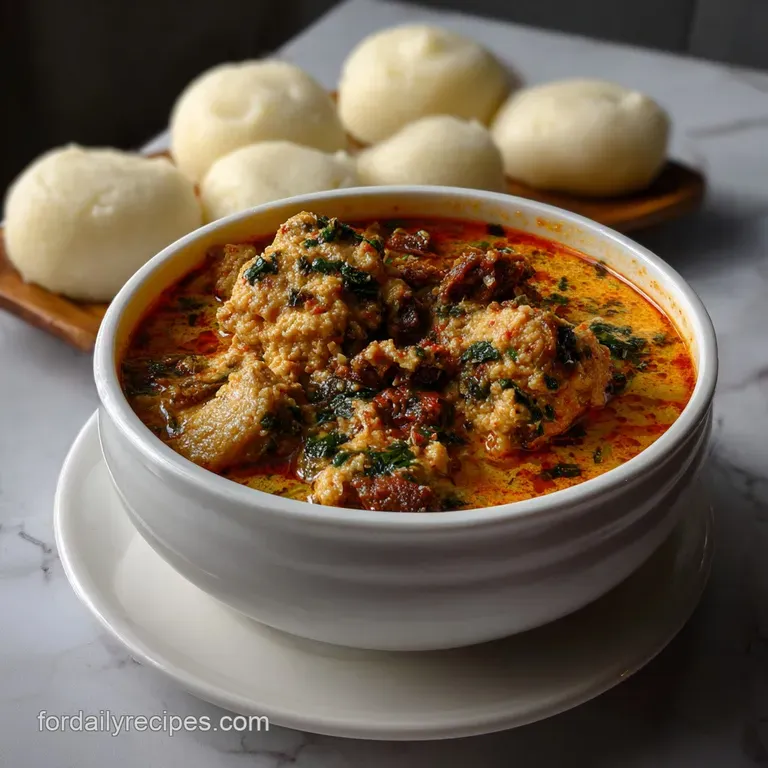
Why My Egusi is Gritty
If the seeds feel like sand, the protein hasn't been properly hydrated or "fried" long enough. The 2.5 cups ground egusi seeds must be toasted in the 1 cup red palm oil to break down the outer cell walls of the melon seeds.
| Problem | Root Cause | The Fix | Pro Protocol |
|---|---|---|---|
| Watery Soup | Excess broth or under simmered egusi | Simmer uncovered for 10 mins | Reduce broth separately before adding to the oil base. |
| Lumpy Fufu | Adding flour to water too fast | Sift flour in while whisking | Use a helper to pour while you stir at high velocity. |
| Bitter Aftertaste | Scorched iru or unwashed greens | Lower heat during aromatics | Always add iru after the liquid base is established. |
Chef's Tip: For a deeper flavor, let your smoked fish soak in the warm beef broth for 10 minutes before adding it to the pot. This rehydrates the fish and releases trapped oils into the soup base.
⚗️ The Scaling Lab: Physics of Large Batch Cooking
When doubling this egusi and fufu recipe for a crowd (12 servings), you must respect the laws of thermodynamics.
- The Evaporation Paradox: In a 12 quart pot, the surface area does not double alongside the volume. If you use 8 cups of water, your soup will likely be too thin. Reduce the added water by 15% (use approx 6.5 7 cups total) to maintain the correct viscosity.
- Maillard Interference: Doubling the 2 lbs beef chuck in one pot will drop the oil temperature significantly. Sauté the meat in two separate batches to ensure a proper sear rather than steaming the protein.
- The Fufu Fatigue: Scaling 4 cups of fufu flour to 8 cups requires immense physical strength. The starch gelatinization happens faster than you can stir in large volumes. Work in two separate pots to ensure the fufu remains smooth and lump free.
- Carry Over Heat: A double batch of egusi and fufu soup holds thermal mass longer. Remove the pot from the stove 5 minutes earlier than usual, as the residual heat will continue to wilt the 8 cups of spinach long after the burner is off.
Flavor Architecture: Creative Variations
While authentic egusi and fufu is a masterpiece of its own, the "soup and swallow" framework allows for incredible flexibility. If you've mastered this, you might find the balance of flavors similar to the tangy creamy profile of a 1000 Island Dressing Recipe, though on a much more savory scale.
- Seafood Extravaganza: Replace the 2 lbs beef chuck with 1 lb jumbo shrimp and 1 lb calamari. Add the seafood in the last 5 minutes of simmering to prevent the protein from becoming rubbery (denaturation occurs much faster in shellfish).
- Vegan Egusi Swap: Substitute the meats with 2 lbs extra firm tofu (pressed and seared) and 1 lb king oyster mushrooms. Use mushroom bouillon instead of beef powder. The mushrooms provide the necessary "chew" and umami to mimic the tripe.
- Keto Friendly "Fufu": For those avoiding the 62g of carbohydrates, replace the 4 cups fufu flour with a cauliflower and psyllium husk mash. It won't have the same "stretch," but it acts as a functional vessel for the nutrient dense soup.
Common Myths vs. Scientific Reality
Myth: You must boil the egusi seeds for hours to make them digestible. Truth: Egusi seeds are mostly fat and protein; they cook in minutes. The long cook time in an egusi and fufu recipe is strictly for the beef and the integration of flavors.
Myth: The red oil on top is a sign of a "bad" greasy soup. Truth: In West African culinary science, the oil separation (the "bleeding") is proof that the water has evaporated sufficiently and the flavors have concentrated. It is a visual cue for perfection.
Storage and Zero Waste Philosophy
- Fridge
- Store soup and fufu in separate airtight containers for up to 4 days.
- Freezer
- The soup freezes perfectly for 3 months. However, fufu does not freeze well it loses its "stretch" and becomes crumbly upon thawing.
- Reheating
- Reheat soup on the stovetop with 2 tbsp of water to loosen the fats. For fufu, microwave with a damp paper towel for 60 seconds to re-steam the starch.
💡 ZERO WASTE: Don't discard the beef trimmings or smoked fish bones. Transform: Simmer the scraps in 2 cups of water for 1 hour to create a "quick stock." Science: The residual collagen and calcium in the bones create a liquid umami bomb you can use for your next batch of Jollof rice or even a batch of Sugar Cookies recipe if you're adventurous with savory sweet profiles.
Serving Suggestions: The Tactile Experience
Eating egusi and fufu is a sensory protocol. Tradition dictates eating with the right hand. 1. Pinch off a small piece of the warm, elastic fufu. 2. Roll it into a smooth ball in your palm. 3. Press your thumb into the center to create a "scoop." 4.
Dip the scoop into the mahogany colored egusi soup, ensuring you grab a "clump" of seed and a piece of the fork tender beef. 5. Swallow without chewing the fufu excessively; the texture is designed to be a "swallow."
The contrast of the 1142 kcal rich soup against the neutral, tangy fufu creates a palate cleansing cycle that allows you to eat a substantial portion without flavor fatigue. This egusi and fufu is more than a meal; it's a masterclass in African thermodynamics and flavor layering.

Recipe FAQs
Is egusi soup supposed to have oil floating on top?
Yes, the oil pooling is a sign of success. In West African culinary science, this "bleeding" proves the water content has reduced adequately and flavors are concentrated. It is a visual cue for perfection in the emulsion.
Can I substitute red palm oil with vegetable oil?
Unsalted butter for precision control. Salted brands vary (80-200mg sodium per tbsp), making standardization impossible. Unsalted lets you adjust salt based on cheese/bacon content.
What is the essential difference between egusi and fufu?
Egusi provides the savory, nutty emulsion. Egusi is the protein/lipid rich soup base where seeds form curds via oil searing, contrasting sharply with fufu, which is the pure starch component.
Why did my fufu turn out hard and lumpy?
Cold cheese added to hot liquid causes protein clumping. Temperature shock denatures casein proteins, creating grainy texture instead of smooth emulsion.
- Remove pan from heat first
- Add cheese in small handfuls
- Use fresh grated Gruyère (pre-shredded has cellulose coating)
Can I make the egusi soup ahead of time without the fufu?
Yes, the soup stores well due to high fat content. Storing the soup separately preserves the lipid emulsification stability achieved by toasting the egusi in palm oil. If you enjoyed mastering the technique of protein searing here, see how the same principle applies to achieving bark on slow smoked meats in our Rib Rub Recipe: The Proper Belter BBQ Blend (Low and Slow).
Does using smoked turkey instead of smoked fish alter the flavor profile greatly?
Smoked turkey imparts a deeper, earthier background note. The lighter, sharper salinity of smoked fish differs from the heavier smoke and larger collagen structure of turkey, yielding a less intense overall umami.
Myth: Iru (locust beans) can be omitted without consequence.
Myth: You can omit iru without consequence. Correction: Iru provides essential volatile aromatic compounds through fermentation that bridge the flavor gap between the heavy fats and the peppers.
Egusi And Fufu Masterclass
Ingredients:
Instructions:
Nutrition Facts:
| Calories | 1142 kcal |
|---|---|
| Protein | 58 g |
| Fat | 76 g |
| Carbs | 62 g |
| Fiber | 7 g |
| Sugar | 4 g |
| Sodium | 1180 mg |
