Chicken Carbonara Recipe
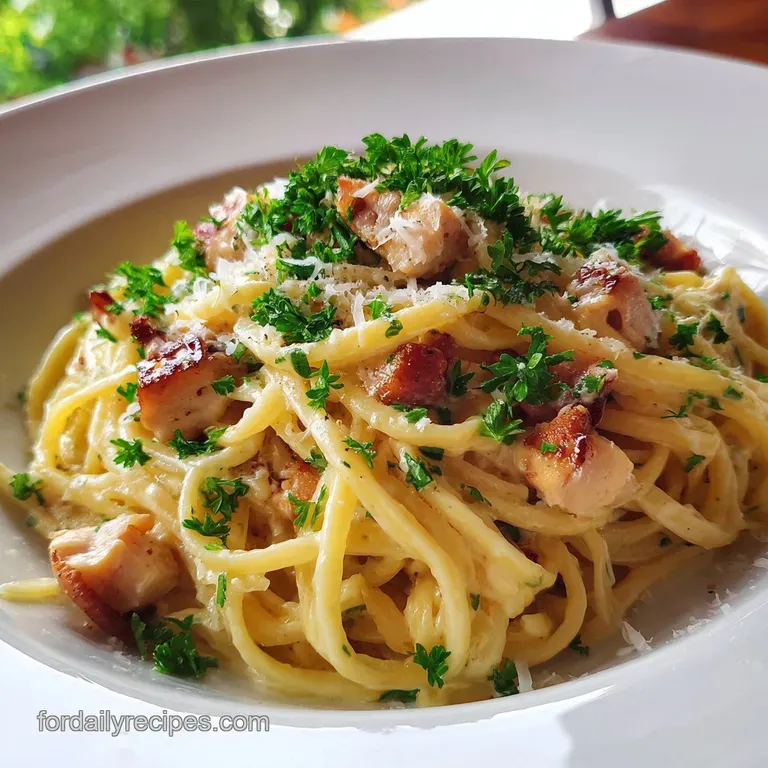
- Time: Active 15 minutes, Passive 10 minutes, Total 25 minutes
- Flavor/Texture Hook: Silky, peppery, and deeply savory
- Perfect for: Heritage style Sunday dinners or a sophisticated weeknight treat
- The Ultimate Silky Chicken Carbonara Recipe
- Building Flavor Layers with Scientific Precision
- Time Honored Specs for Pasta Success
- Selecting Heritage Components for Umami
- Essential Kitchen Gear for Perfect Pasta
- Mastering the Rhythmic Sizzling Cooking Method
- Solving Common Sauce and Texture Errors
- Creative Swaps for Modern Family Meals
- Debunking Popular Pasta Myths
- Storing and Saving Your Leftover Pasta
- Elegant Serving and Finishing Secrets
- Very High in Sodium
- Recipe FAQs
- 📝 Recipe Card
The Ultimate Silky Chicken Carbonara Recipe
I remember my grandmother standing over a steaming pot of pasta, her movements practiced and calm, a ritual she had performed for generations. She always said that a true kitchen isn't built on gadgets, but on the heritage of the flavors we pass down through the steam and the sizzle of a hot pan.
This chicken carbonara recipe is my personal tribute to those Sunday afternoons where the scent of cured pork and black pepper felt like the very center of the universe.
For years, I struggled with the sauce turning into a grainy mess of scrambled eggs, a heartbreak any home cook knows too well. But through trial, error, and a lot of patience, I learned that the secret isn't in adding cream it's in the rhythm of the heat.
We are going to build layers of flavor here, starting with the salty rendered fat of guanciale and ending with a velvety, golden cloak of egg and cheese that feels like a warm embrace.
Trust me, once you see that glossy sheen come together in the pan, you'll never look at a jarred sauce the same way again. We're looking for that specific moment where the pasta water and cheese marry perfectly, creating a coating that clings to the spaghetti like a silk ribbon.
Let's get the water boiling and dive into the beautiful science of this time honored dish.
Building Flavor Layers with Scientific Precision
Building a proper carbonara is like a delicate dance between fat, protein, and starch. We aren't just heating ingredients; we are creating a stable emulsion that requires specific temperature control to prevent the proteins in the eggs from tightening and squeezing out moisture.
- Emulsification
- The starchy pasta water acts as a bridge between the fat from the guanciale and the liquid in the eggs, creating a unified, silky sauce.
- Protein Denaturation
- Gentle residual heat slowly uncoils the egg proteins, allowing them to thicken the sauce without clumping into solid curds.
- Starch Gelatinization
- High starch pasta water provides the structural "glue" that prevents the cheese from separating into a rubbery mass.
Chef's Tip: Freeze your guanciale for 10 minutes before dicing. It firms up the fat, allowing you to get those perfectly sharp, uniform cubes that shatter when bitten.
| Meat Thickness | Internal Temp | Rest Time | Visual Cue |
|---|---|---|---|
| 1 cm strips | 165°F (74°C) | 3 minutes | Opaque center with golden edges |
| 2 cm cubes | 165°F (74°C) | 5 minutes | Firm texture, juices run clear |
| Thin medallions | 165°F (74°C) | 2 minutes | Slight char, no pink remaining |
This table helps you judge the poultry perfectly. If you enjoy heartier meals, you might also find comfort in a bowl of Chicken Corn Chowder Recipe on colder evenings. Both dishes rely on that balance of protein and a rich, satisfying base.
| Component | Science Role | Pro Secret |
|---|---|---|
| Egg Yolks | Emulsifier & Fat | Use room temperature eggs to prevent the sauce from "shocking" and breaking. |
| Pecorino Romano | Flavor & Structure | Grate it on the smallest holes of your grater for a powder like texture that melts instantly. |
| Pasta Water | Liquid Gold | This starch heavy liquid is the only "cream" you need for a velvety finish. |
The magic happens when these components meet the heat of the freshly cooked pasta. The residual heat is enough to cook the eggs safely while keeping them in a liquid, saucy state.
Time Honored Specs for Pasta Success
To get this right, we need to respect the quantities. This isn't a "measure with your heart" situation until you've mastered the technique. The ratio of egg to cheese to pasta is what defines the texture of this chicken carbonara recipe.
- Pasta: 1 lb (approx. 450g) of spaghetti or bucatini. Bucatini is lovely because the hollow center traps the sauce.
- Poultry: 2 large chicken breasts (500g), sliced into thin strips for maximum surface area and browning.
- Cured Pork: 5 oz (140g) guanciale or thick cut pancetta. This provides the essential fat base.
- Cheese: 1.5 cups (120g) finely grated Pecorino Romano. Its sharp, salty bite is non negotiable for heritage flavor.
When searing your meat, think of the technique used in a Mexican Chicken Recipe. You want that over high heat sizzle to create a crust, but you must be careful not to overcook the interior, as the chicken will continue to cook slightly when tossed with the hot pasta.
Selecting Heritage Components for Umami
When gathering your ingredients, quality is your best friend. Since there are so few elements, each one has nowhere to hide.
- 1 lb spaghetti or bucatini: Why this? Long strands provide the perfect surface for the silky egg emulsion to cling to.
- Substitute: Fettuccine. It offers a wider surface but a similar bite.
- 2 large chicken breasts (500g): Why this? Lean protein that absorbs the salty fat of the guanciale beautifully.
- Substitute: Boneless chicken thighs. Note: Adds more fat and a slightly juicier texture.
- 5 oz guanciale or thick cut pancetta: Why this? Guanciale (cured pork jowl) provides a unique, funky depth and superior rendering fat.
- Substitute: high-quality thick cut bacon. Note: Adds a smoky note not found in the original.
- 1 tbsp extra virgin olive oil: Why this? Just enough to help the guanciale start rendering without burning.
- Substitute: Grapeseed oil for a more neutral flavor profile.
- 3 large egg yolks + 1 large whole egg: Why this? Extra yolks create the signature golden color and ultra creamy mouthfeel.
- Substitute: 2 whole eggs. Note: The sauce will be lighter and slightly less velvety.
- 1.5 cups (120g) Pecorino Romano: Why this? A sheep's milk cheese that is saltier and sharper than Parmesan.
- Substitute: Parmigiano Reggiano. Note: Results in a sweeter, milder flavor profile.
- 2 tsp freshly cracked black pepper: Why this? The "carbon" in carbonara; it provides the essential spicy counterpoint to the fat.
- Substitute: Pre ground pepper, though you'll lose that sharp, aromatic punch.
- 1 tsp sea salt: Why this? For the pasta water only; the cheese and pork provide the rest.
- Substitute: Kosher salt (use 1.5 tsp).
Essential Kitchen Gear for Perfect Pasta
- 1. Large Pasta Pot
- You need plenty of water to allow the starch to circulate.
- 2. Wide Skillet or Sauté Pan
- Large enough to hold all the pasta and chicken once they are combined.
- 3. Microplane or Fine Grater
- This is crucial. If the cheese is in chunks, it won't melt into the sauce; it will just clump.
- 4. Stainless Steel Tongs
- These are the best for "twirling" the pasta into the sauce and ensuring every strand is coated.
- 5. Mixing Bowl
- Preferably glass or stainless steel, for whisking the eggs and cheese into a thick paste.
Chef's Tip: Whisk your cheese and eggs into a thick, dry paste before you even think about starting the pasta. This "paste method" ensures the cheese is fully hydrated by the egg, which helps prevent clumping when it hits the hot pan.
Mastering the Rhythmic Sizzling Cooking Method
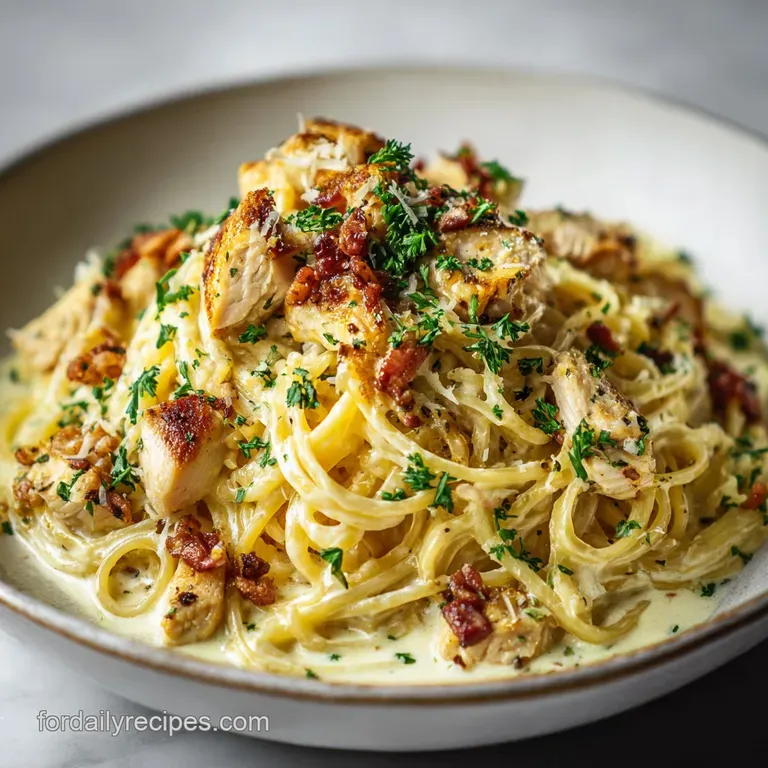
- Prep the base. Whisk the 3 egg yolks, 1 whole egg, 1.5 cups Pecorino, and 2 tsp black pepper in a bowl until a thick, pale yellow paste forms. Note: This prevents the eggs from scrambling later.
- Sizzle the pork. Place the 5 oz diced guanciale and 1 tbsp olive oil in a cold skillet. Turn heat to medium and cook 8 minutes until the fat has rendered and the bits are golden and shatter crisp.
- Sear the poultry. Remove the pork with a slotted spoon, leaving the fat. Add the 500g chicken strips. Cook 5 minutes until the edges are caramelized and the meat is opaque.
- Boil the pasta. While the chicken cooks, drop your 1 lb spaghetti into boiling salted water. Cook until it is 2 minutes shy of al dente. Note: It finishes cooking in the sauce.
- Reserve the liquid. Before draining, scoop out 2 cups of the cloudy pasta water. This is your "liquid gold."
- Combine the foundations. Add the cooked pork back into the skillet with the chicken. Transfer the hot pasta directly from the water into the skillet using tongs.
- Toss and coat. Add 1/2 cup of pasta water to the skillet. Toss vigorously over medium heat for 1 minute until the water has mostly evaporated and the pasta looks glossy.
- The critical temper. Remove the skillet from the heat entirely. This is vital! Wait 30 seconds for the pan to cool slightly.
- Emulsify the sauce. Pour the egg and cheese mixture over the pasta. Toss continuously while slowly drizzling in another 1/2 cup of pasta water.
- Final finish. Keep tossing for 2 minutes until the sauce thickens into a velvety, cream like coating that clings to the noodles. If it’s too thick, add a splash more water.
Solving Common Sauce and Texture Errors
The biggest fear here is the "scrambled egg" disaster. It happens to the best of us, but it's usually a result of the pan being too hot when the eggs are added.
Rescuing a Grainy Sauce
If your cheese has clumped into rubbery balls, the temperature was likely too high, or the cheese was grated too coarsely. While you can't "un clump" it perfectly, adding a splash of very hot pasta water and whisking vigorously can sometimes smooth out the surrounding sauce.
Fixing a Dry Pasta
Carbonara thickens as it sits. If your pasta looks dull or sticky, it needs more hydration. Always keep that extra cup of pasta water handy; it acts as a lubricant to bring the shine back to the dish.
| Problem | Root Cause | Solution |
|---|---|---|
| Watery Sauce | Too much pasta water added at once | Simmer on very low heat while stirring constantly; the eggs will eventually thicken. |
| Scrambled Eggs | Added eggs to a pan that was still on the flame | Remove from heat next time and wait 30 seconds before adding the mixture. |
| Lack of Flavor | Not enough pepper or under salted water | Add more cracked pepper at the very end and a pinch of salt if needed. |
Common Mistakes Checklist: ✓ Forgetting to save pasta water before draining (the most common heartbreak). ✓ Using pre shredded cheese from a bag (the starch coating prevents melting). ✓ Using only whole eggs (you need those extra yolks for the velvety fat content).
✓ Rinsing the pasta (this removes the starch needed to bind the sauce). ✓ Adding the egg mixture while the burner is still on.
Creative Swaps for Modern Family Meals
While I’m a bit of a traditionalist, I know that sometimes the pantry doesn't cooperate. If you want a different experience, these changes can help you adapt.
Scaling for the Family: Down (1/2 size): Use 1/2 lb pasta and 1 chicken breast. Use 2 egg yolks and skip the whole egg. Reduce the Pecorino to 3/4 cup. Cook times remain mostly the same, but watch the chicken closely as it will sear faster.
Up (Double size): Work in two separate skillets for the final toss. Doubling the pasta in one pan often leads to uneven sauce distribution and "clumping" because you can't toss the volume fast enough. Increase the pepper to 3 tsp, not 4, to avoid overwhelming the dish.
| Premium Ingredient | Budget Alternative | Flavor Impact | Savings |
|---|---|---|---|
| Guanciale | Thick cut Bacon | Adds smokiness; less "funk" | Save $5-7 |
| Pecorino Romano | Parmesan (canned/shaker) | Note: Will be gritty and won't melt. Avoid. | Not recommended |
| Fresh Bucatini | Dried Spaghetti | Slightly less "chew" but very reliable | Save $3-4 |
If you find yourself with extra chicken and want to try something with more zing, our Mexican Chicken Recipe is a great way to use up those leftover breasts in a completely different flavor profile.
Debunking Popular Pasta Myths
Myth: You need heavy cream for a "creamy" carbonara. This is perhaps the most debated topic in Italian cooking. Authentic carbonara relies entirely on the emulsion of egg, cheese, and starch. Adding cream mutes the sharp flavor of the Pecorino and makes the dish unnecessarily heavy.
The creaminess should come from the technique, not the carton.
Myth: Searing the chicken "seals in" the juices. Moisture loss happens regardless of the sear. The real reason we sear the chicken in the rendered guanciale fat is for the Maillard reaction that golden brown crust that adds a deep, savory complexity to the meat.
Storing and Saving Your Leftover Pasta
Storage: This chicken carbonara recipe is best eaten immediately, as the emulsion is most stable when fresh. However, you can store leftovers in an airtight container in the fridge for up to 2 days. The sauce will thicken and become firm as it cools.
Zero Waste: Don't toss those leftover egg whites! Use them for a healthy omelet the next morning or whip them into a meringue. If you have leftover chicken bits that didn't make it into the pasta, they are great cold on a salad the next day.
Reheating: Never use the microwave for carbonara; it will turn your silky sauce into scrambled eggs in seconds. Instead, place the pasta in a skillet over low heat with a splash of water or milk. Stir constantly just until it becomes loose and glossy again.
Elegant Serving and Finishing Secrets
When you're ready to serve, the presentation should match the heritage of the dish. I love to use wide, shallow bowls that have been slightly warmed in the oven. A warm bowl keeps the sauce from seizing up before it hits the table.
Twirl a generous portion of the spaghetti into a nest using a large fork and a ladle. Top with a few extra pieces of the shatter crisp guanciale and the golden chicken strips. A final, aggressive dusting of Pecorino Romano and another crack of black pepper is essential.
It looks beautiful, smells like a Roman bistro, and tastes like home.
This dish is a testament to the fact that we don't need complicated ingredients to make something spectacular. We just need to respect the process, learn from our mistakes (like those scrambled eggs of my past!), and keep the heritage of home cooking alive in our own kitchens. Right then, let's eat!
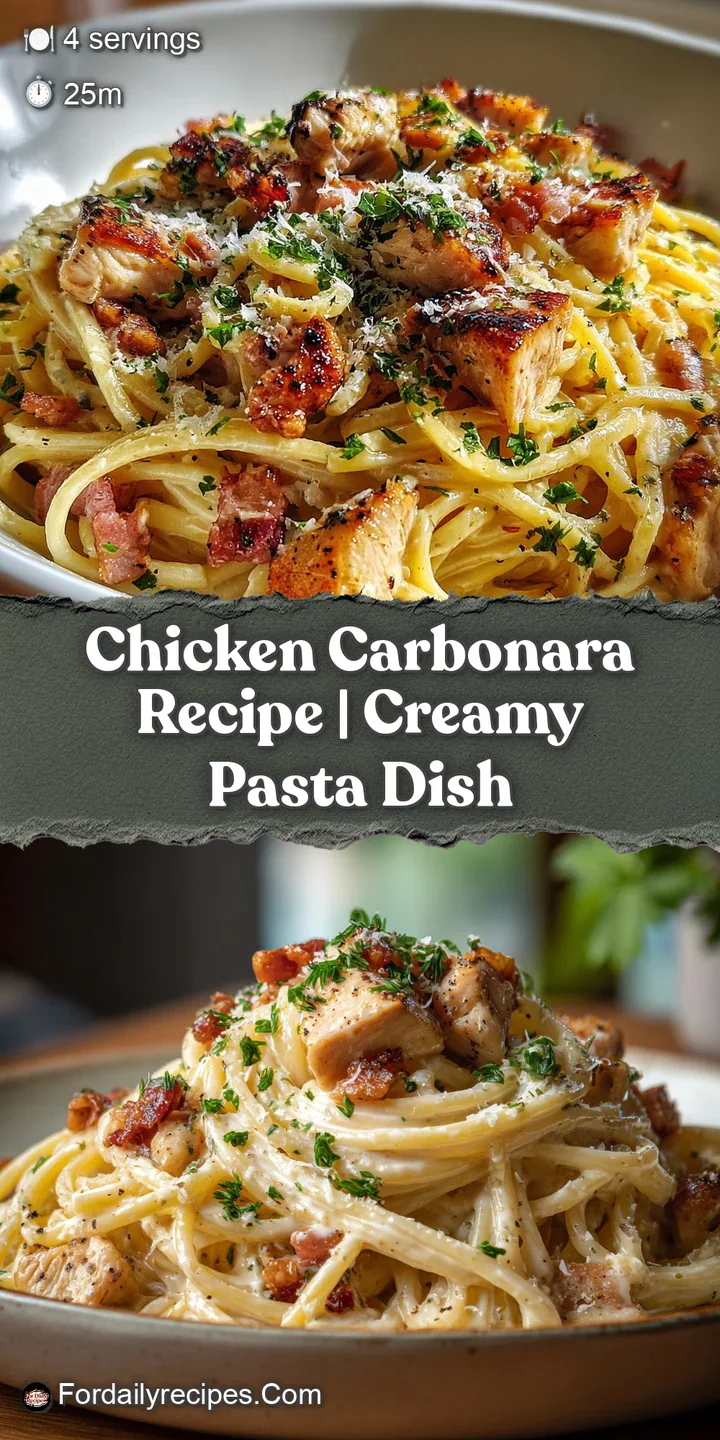
Very High in Sodium
1450 mg mg of sodium per serving (63% % of daily value)
The American Heart Association recommends limiting sodium intake to no more than 2,300mg per day for most adults. Ideally, aiming for 1,500mg per day is even better for heart health.
Sodium Reduction Tips for Your Carbonara Recipe:
-
Reduce Guanciale/Pancetta-25%
Guanciale and pancetta are major sources of sodium. Reduce the amount used by half, or substitute with a lower sodium option like lean, unsmoked bacon (use sparingly and check the label).
-
Lower Sodium Cheese-15%
Pecorino Romano is very high in sodium. Reduce the amount by 25% and consider substituting part of it with a lower sodium hard cheese like Parmesan (in moderation) or a combination of cheeses to balance flavor and sodium.
-
Omit Salt in Water-10%
You can skip adding salt to the pasta water. While traditionally added for flavor, it significantly increases the overall sodium content. The sauce will provide plenty of flavor.
-
Adjust Egg Yolks-5%
Increase the number of whole eggs and decrease the number of yolks. Yolks contain more sodium than egg whites, so balancing them out will slightly lower the sodium.
-
Flavor Boost
Enhance the flavor with fresh herbs and spices. Add ingredients like garlic powder, onion powder, oregano, basil, or red pepper flakes to create a flavorful dish without adding sodium.
Recipe FAQs
What are the ingredients in chicken carbonara?
The core ingredients are pasta, chicken, eggs, Pecorino Romano cheese, and black pepper. Authentic carbonara uses guanciale (cured pork jowl) or pancetta for richness, but chicken breast is a popular addition for protein. The sauce is created by emulsifying egg yolks, cheese, and starchy pasta water.
What are the 4 ingredients in carbonara?
Traditionally, carbonara is made with pasta, guanciale, eggs, and Pecorino Romano cheese. Black pepper is considered essential for the "carbon" aspect. While chicken is often added in variations like chicken carbonara, it's not part of the classic four.
What is the secret to making carbonara?
The secret is controlling the heat to create a stable emulsion without scrambling the eggs. This involves removing the pan from the heat before adding the egg and cheese mixture, then tossing vigorously with starchy pasta water to create a silky, glossy sauce.
What is carbonara sauce made of?
Carbonara sauce is primarily made of egg yolks, finely grated Pecorino Romano cheese, and rendered pork fat. Starchy pasta water is then whisked in to emulsify the sauce, creating a rich, creamy coating without any dairy cream.
Can I use pancetta instead of guanciale in chicken carbonara?
Yes, pancetta is a good substitute for guanciale. While guanciale (cured pork jowl) offers a richer, more distinct flavor, pancetta (cured pork belly) is readily available and provides a similar salty, fatty base for the sauce.
Why does my carbonara sauce scramble?
Your carbonara sauce likely scrambled because the pan was too hot when you added the egg mixture. The residual heat from the pasta and pan is enough to cook the eggs gently. If the burner is still on or the pan is too hot, the eggs will cook too quickly and curdle.
Do I need to use Pecorino Romano cheese?
Pecorino Romano is traditional and highly recommended for its sharp, salty flavor. While Parmigiano Reggiano can be used, it has a milder, sweeter profile that changes the authentic taste of carbonara. If you enjoyed mastering the flavor balance here, you might appreciate how we achieve a similar savory depth in our Smoky Broth Recipe.
Chicken Carbonara Recipe
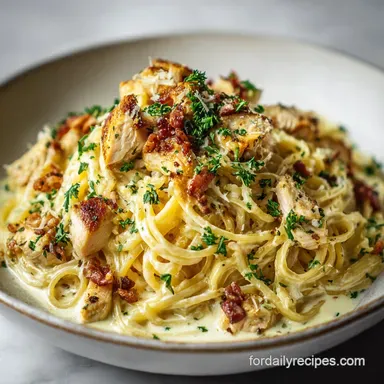
Ingredients:
Instructions:
Nutrition Facts:
| Calories | 939 kcal |
|---|---|
| Protein | 58g |
| Fat | 37g |
| Carbs | 84g |
| Fiber | 3g |
| Sugar | 1g |
| Sodium | 1450mg |
