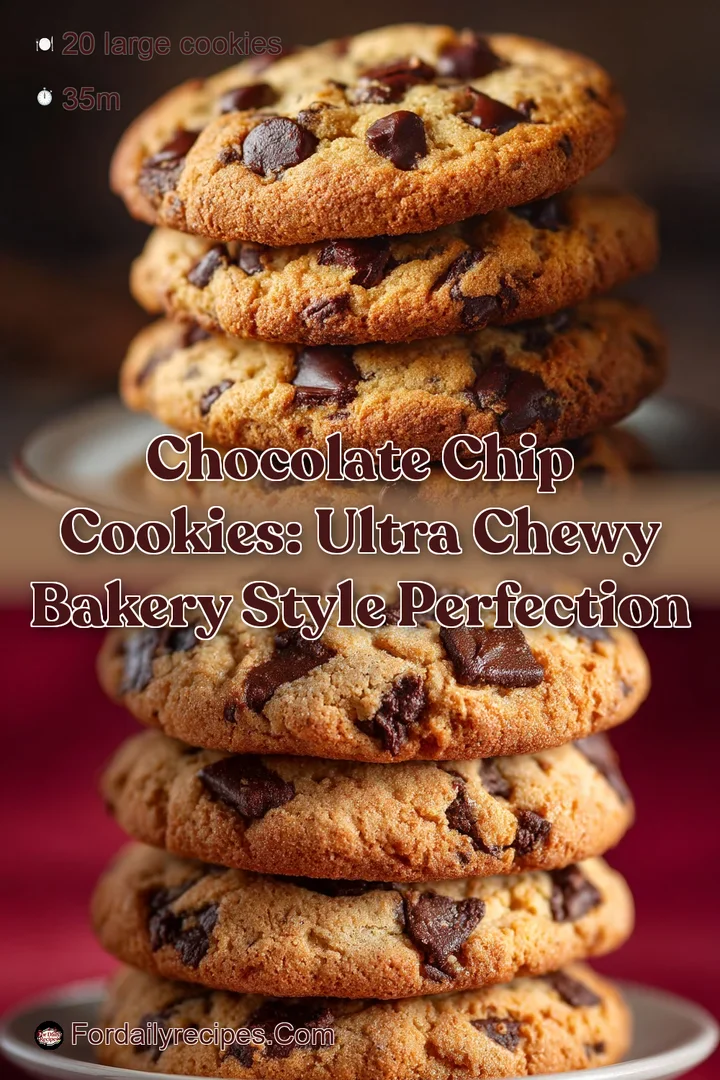
Chocolate Chip Cookies: Ultimate Chewy Bakery Style
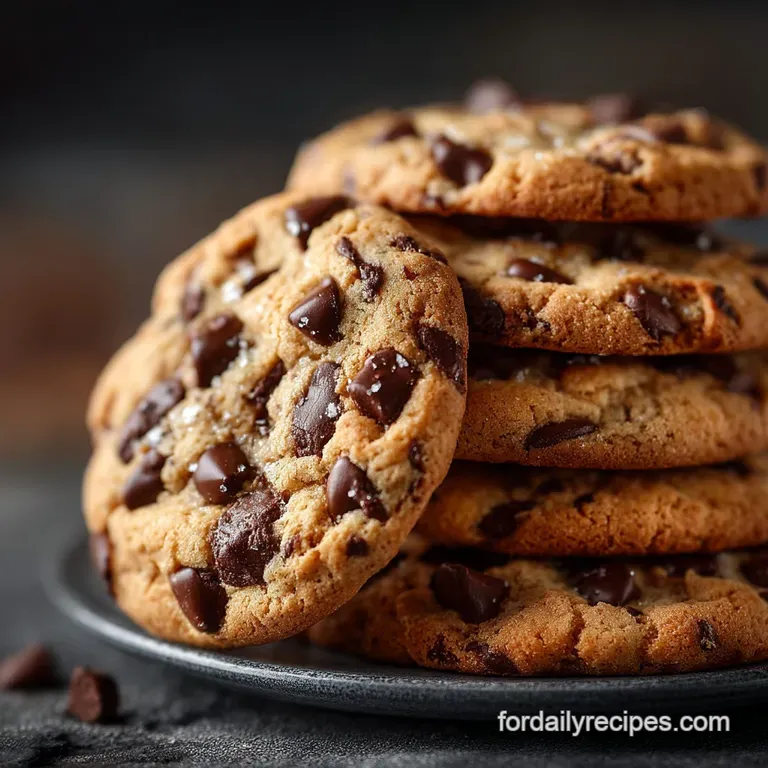
- Welcome to Your New Gold Standard Cookie Recipe
- The Science Behind the Superior Chew and Crinkle
- Essential Ingredients for Perfect Chocolate Chip Cookies
- Mixing, Resting, and Baking: The Detailed Method
- Troubleshooting: Avoiding Flat Cookies and Other Common Pitfalls
- Maximizing Freshness: Storing and Freezing Your Dough
- The Perfect Finish: Serving and Pairing Suggestions
- Recipe FAQs
- 📝 Recipe Card
Welcome to Your New Gold Standard Cookie Recipe
Can you smell that? It’s the deep, caramel scent of brown sugar melting into butter, spiked with rich vanilla and a hint of salinity. That complex aroma, coupled with the soft resistance of a thick, chewy center, is exactly what we are chasing with this definitive Chocolate Chip Cookies recipe.
We are talking about true bakery style perfection, not those sad, flat discs that disappear the second you take them off the tray.
Look, I get it; there are a million recipes out there, but this one is a true lifesaver because it relies on two cheap, foundational ingredients butter and flour elevated by patience.
Once you master the technique (which isn't hard, I promise!), you can make the dough ahead and stash it in the freezer for emergency comfort food whenever life throws you a curveball.
I’ve made all the mistakes: using cold butter, skipping the chill time, and pulling them out too early or too late. Now, I’m sharing the absolute, non-negotiable science behind truly superior, thick, and chewy Chocolate Chip Cookies.
Let’s get you baking the Best Chocolate Chip Cookie Recipe you’ll ever try.
The Science Behind the Superior Chew and Crinkle
This isn't just mixing ingredients; it’s chemistry, baby. The reason my Chocolate Chip Cookies recipe works so well is that we manipulate temperature and moisture, allowing the flavours to concentrate and the structure to set perfectly.
We ditch the traditional creaming method temporarily and embrace brown butter.
What Makes a Cookie Truly 'Bakery Style'?
Bakery style always means girth. We want a cookie that holds its shape, boasts a slightly crisp, crinkled edge, and stays gloriously soft in the middle. Achieving this perfect balance in your Chewy Chocolate Chip Cookies comes down to flour hydration and controlling spread.
Too much moisture or too much heat too quickly, and your dreams of thick cookies turn into thin, greasy puddles.
The Non-Negotiable Step: Why We Chill the Dough
Skipping the chill time is the single greatest sin in home baking. When you chill the dough, two magical things happen: first, the moisture in the dough slowly hydrates the flour, meaning less spreading in the oven and a softer crumb.
Second, the brown butter and sugars get acquainted, concentrating that deep, caramelized flavour we crave in our Chocolate Chip Cookies. Trust me, the wait is worth it for these amazing Chocolate Chip Cookies .
A Flavour Deep Dive: The Brown Butter Advantage
This is my secret weapon. By browning three quarters of the butter, we introduce incredible, complex nutty notes (the Maillard reaction in action!). The remaining cold butter you add helps the mixture cool down faster and adds necessary fat structure for creaming, without making the dough greasy.
You will never go back to standard melted butter once you taste Soft Chocolate Chip Cookies made this way. I remember the first time I tried this; I accidentally burned the first batch of butter. Don't be me; watch it like a hawk!
Mastering the Maillard Reaction: Browning the Butter Properly
The goal is a deep, amber colour and a rich, nutty scent, which takes about 5 to 8 minutes over medium heat. Don't rush this part. Watch the milk solids sink to the bottom and turn golden brown, then immediately remove the pan from the heat.
Crucially, scrape all those delicious brown bits into your mixing bowl. They are pure flavour gold and essential for the best Chocolate Chip Cookies .
The Role of Sugar Ratios in Spread and Texture
We use a high ratio of brown sugar to white sugar because brown sugar contains molasses, which is acidic and retains moisture. This guarantees a softer, chewier texture. The granulated white sugar helps promote spread and crispy edges.
Adjusting this ratio is how bakers control the final texture of their Chocolate Chip Cookies Recipe .
Achieving That Perfect Thick Center
We use two types of leaveners: baking soda for spread and surface browning, and baking powder for lift (puffiness). Combined with the extra egg yolk, which acts as a binder and fat source, these elements ensure the dough holds its shape high and proud, delivering a wonderfully thick, fudgy center.
This technique is designed specifically for creating the most satisfying Chocolate Chip Cookies .
Chef's Note: If you want truly massive, thick cookies, try shaping the dough balls like tall cylinders rather than round spheres before chilling. This forces them to spread upwards instead of outwards.
Essential Ingredients for Perfect Chocolate Chip Cookies
Good ingredients equal great results. Don't skimp on the chocolate or the vanilla if you want that truly impressive flavour profile in your Easy Chocolate Chip Cookies .
Choosing the Right Chocolate: Chips, Chunks, or Discs?
Forget the basic chips if you want those gorgeous pools of melted chocolate you see on Pinterest. I use a mix: 2/3 chopped dark chocolate bar (around 65 70% cacao) for the big puddles, and 1/3 high-quality semi sweet chips for structure. The variety makes all the difference!
| Ingredient | Why it's Important | Substitution/Adjustment |
|---|---|---|
| Brown Sugar | Moisture and molasses; creates chewiness. | You can use all granulated sugar, but the cookies will be thinner and crispier. |
| All-Purpose Flour | Structure and body. | If you only have Bread Flour, use 1/4 cup less, as it has higher protein and can make the cookies tough. |
| Unsalted Butter | Fat and flavour foundation. | Can use salted butter, but reduce the recipe’s added salt by half a teaspoon. |
| Eggs (Room Temp) | Binding and emulsifying. | If cold, place them in a bowl of warm water for 5 minutes. |
| Baking Soda + Powder | Lift and pH balance. | If you don't have baking powder, increase baking soda to 1.5 tsp, but expect slightly flatter cookies. |
The Difference Between Flours (AP vs. Bread Flour Potential)
We are calling for All-Purpose flour here because it gives a great balance between softness and structure. If you happen to be out, you can substitute bread flour, which is higher in protein, but you must be careful.
If you use bread flour, make sure you don't overmix and reduce the quantity slightly (about 1/4 cup less) to prevent the cookies from becoming dense and hard.
Understanding Egg Temperature and Its Impact on Dough Structure
Cold eggs shock the butter mixture, causing it to seize up and resulting in a lumpy dough that won't emulsify properly. Room temperature eggs blend smoothly into the creamed butter and sugar, creating a uniform mixture that traps air perfectly.
This uniform base is absolutely key for achieving soft, fluffy Chocolate Chip Cookies Chewy .
Salt and Vanilla: Flavour Amplifiers
Use the full tablespoon of vanilla; I know it sounds like a lot, but trust me. Pure vanilla extract deepens the caramel and butter notes. The salt, especially the flaky sea salt sprinkled on top, cuts through the sweetness and heightens all the other flavours. If you are baking something like my Lactation Cookies: Chewy Oatmeal Recipe for Maximum Milk Supply , salt plays the same crucial role, even with oatmeal involved!
Mixing, Resting, and Baking: The Detailed Method
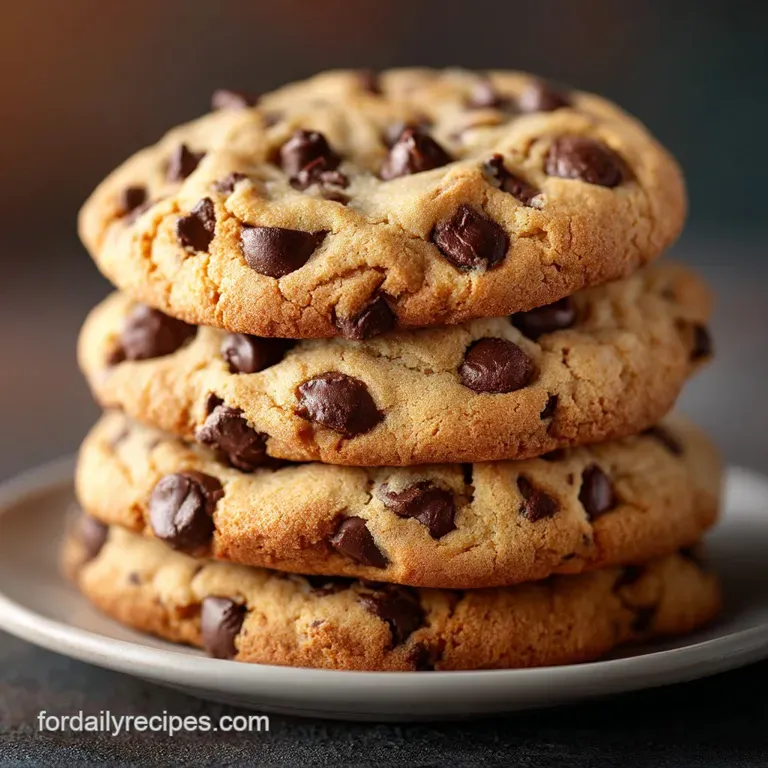
Now, let's turn these beautiful ingredients into the best Chocolate Chip Cookies ever. Follow these steps exactly; precision matters here!
step-by-step: Transforming Butter into Liquid Gold (The Browning Process)
Get your saucepan ready. Melt that butter over medium heat, stirring with a wooden spoon. It will foam violently, then quiet down. Watch for the tiny brown specks forming on the bottom and a nutty aroma rising up.
Immediately pour the hot butter and the solids into your mixing bowl, then quickly add the remaining cold butter to halt the cooking process. The resulting mixture should be warm, not searing hot.
The Creaming Stage: Combining Sugars and Fats Correctly
Once the brown butter mixture is the right temperature (just warm to the touch), add both sugars. Beat this for a full 2– 3 minutes until the mixture lightens dramatically in colour and becomes incredibly fluffy. This process incorporates air, which helps the cookies rise and stay airy.
Add the egg, yolk, and vanilla, mixing only until combined.
Portioning and Preparing for the Overnight Rest
Use that large cookie scoop! Big scoops (about 3 tablespoons) help produce thick centers. Roll them into smooth, slightly cylindrical balls and place them on a parchment lined tray. Covering them tightly prevents the surface of the dough from drying out in the fridge.
That chill time is mandatory for superior Chocolate Chip Cookies .
Perfecting the Bake: Achieving the Golden Edges
Preheat your oven fully. Place the chilled dough balls on the prepared tray, keeping them at least three inches apart. We want space for spread! Bake for 12– 15 minutes, rotating the pan halfway through.
When you pull them out, the edges should be a rich golden brown, but the very center should still look puffy and slightly doughy.
Troubleshooting: Avoiding Flat Cookies and Other Common Pitfalls
We’ve all had those tragic moments where we open the oven to find thin, sad disks instead of glorious Chocolate Chip Cookies Tasty . Here are the main culprits.
My Cookies Are Spreading Too Much: Diagnosis and Fixes
If your cookies spread too thin, the likely culprit is warm dough or too much softened butter. Fixes: Ensure your dough is properly chilled (at least 12 hours is best).
Try adding 1 2 tablespoons of flour to the remaining dough, or place the entire baking sheet in the freezer for 10 minutes just before baking.
High Altitude Baking Adjustments
If you live way up high, lower air pressure can make your leaveners overachieve, causing a quick, dramatic rise followed by a major collapse (leading to flat cookies). Fixes: Reduce your baking soda/powder by 1/4 teaspoon and increase your oven temperature by 15°F (to set the structure faster).
You might also need 1 or 2 extra tablespoons of flour to compensate for dryness.
The Thermometer Check: Is Your Oven Lying?
Oven temperatures are notoriously inaccurate. If you consistently struggle with flat or burned edges, your oven thermometer is probably lying to you. Invest in a cheap oven thermometer! I baked at the wrong temperature for years before realizing my 350°F setting was actually 375°F.
Maximizing Freshness: Storing and Freezing Your Dough
These Chocolate Chip Cookies are best eaten warm, but proper storage means you can enjoy them for days, or even weeks!
Short Term Storage: Keeping Baked Cookies Soft
Once fully cooled, store your baked cookies in an airtight container at room temperature. Want to keep them ultra soft? Throw half a slice of sandwich bread into the container. The cookies will absorb moisture from the bread, staying wonderfully soft for 3 5 days. Change the bread out every day or two.
Freezing Unbaked Dough Balls for Future Use
This is the ultimate convenience hack. Once the dough balls are scooped and chilled, transfer them to a freezer bag or airtight container. They freeze beautifully for up to 3 months. Don't worry about freezer burn; the high fat and sugar content protects them!
Having frozen dough on hand means you’re always just 15 minutes away from fresh, warm Easy Chocolate Chip Cookies .
Baking Straight From Frozen (No Thawing Required)
Yes, you can bake them immediately! Simply add 2– 4 minutes to the total baking time. This is my preferred method because the cold center ensures minimal spreading, guaranteeing thick, beautiful results every time.
Just remember to still sprinkle on that flaky salt before popping them in the oven.
The Perfect Finish: Serving and Pairing Suggestions
Is there anything better than a warm cookie? Probably not. We have discussed how to create the best texture, and now it’s time to enjoy the fruits of your patience. These Chocolate Chip Cookies Recipe delights are fantastic on their own, but pairing them elevates the experience. If you’re looking for other hearty, feel good baking projects, you might also like my take on Lactation Cookies: Chewy Oatmeal Recipe for Maximum Milk Supply — they use similar chewy techniques!
My favorite way to serve them is simple: slightly cooled, so the chocolate is still molten, alongside a huge glass of cold whole milk. Seriously, nothing beats that classic combination. You could also crumble a few over vanilla ice cream with a drizzle of salted caramel.
Mastering this ultimate bakery style method guarantees you’ll never suffer through another flat, crispy cookie again. Go chill that dough, and prepare yourself for the best Chocolate Chip Cookies experience of your life. Enjoy!
Recipe FAQs
Why is the overnight dough chilling period so critical for achieving the "bakery style" texture?
Chilling allows the flour to fully hydrate, preventing the cookies from spreading too quickly in the oven and ensuring a thicker, more textured profile. Crucially, it concentrates the browned butter and sugar flavors, leading to the deep, complex "bakery style" taste we are aiming for.
This mandatory rest results in superior chewiness and flavor depth.
My cookies came out flat and greasy, not thick and chewy. What went wrong?
Excessive spreading is typically caused by insufficient dough chilling, using butter that was too hot when mixed, or using expired leavening agents like baking soda. Ensure your oven temperature is accurate and that your baking sheets are cool before placing the dough balls on them.
If the dough was properly chilled but still spreads, try adding one extra tablespoon of flour per cup of dough.
Is browning the butter truly necessary, or can I use regular melted butter?
While you can use regular melted butter, browning the butter is essential to achieving the rich, nutty, toffee like complexity that truly distinguishes this recipe as "ultimate bakery style." The caramelized milk solids add a depth of flavor that cannot be achieved with standard butter.
Ensure the browned butter cools slightly before mixing it with the sugars.
Can I substitute the required brown sugar with granulated white sugar?
No, using only white sugar will significantly alter the texture, resulting in a drier, crispier cookie rather than the desired moist, chewy center. Brown sugar is hygroscopic, meaning it retains moisture, which is necessary for the chewy texture and helps prevent rapid spreading.
It also adds a subtle acidic component that reacts favorably with the leaveners.
How should I store the leftover baked cookies to keep them soft and chewy?
Store baked cookies at room temperature in an airtight container for up to five days. For maximum chewiness and moisture retention, include half a slice of plain white bread in the container; the cookies will absorb the moisture from the bread. Do not store them in the refrigerator, as this can dry them out faster.
What is the best way to freeze the dough for baking later?
Scoop the chilled dough balls onto a parchment lined baking sheet and freeze them until they are completely solid, which usually takes about two hours. Once frozen, transfer the solid dough balls to a heavy duty freezer bag or airtight container, where they can be kept for up to three months.
To bake, place the frozen dough directly onto the baking sheet and add 2 4 minutes to the typical baking time.
My cookie edges burn before the centers are fully set. How can I prevent this?
This often indicates that your oven temperature is too high or your baking sheets are too dark, which absorbs excessive heat. Try reducing your oven temperature by 25°F and extending the baking time slightly, or use light colored, high-quality baking sheets.
Additionally, ensure the dough balls are uniform in size to ensure even cooking across the tray.
Bakery Style Chewy Chocolate Chip Cookies
Ingredients:
Instructions:
Nutrition Facts:
| Calories | 270 calories |
|---|---|
| Fat | 15 g |
| Fiber | 1 g |
